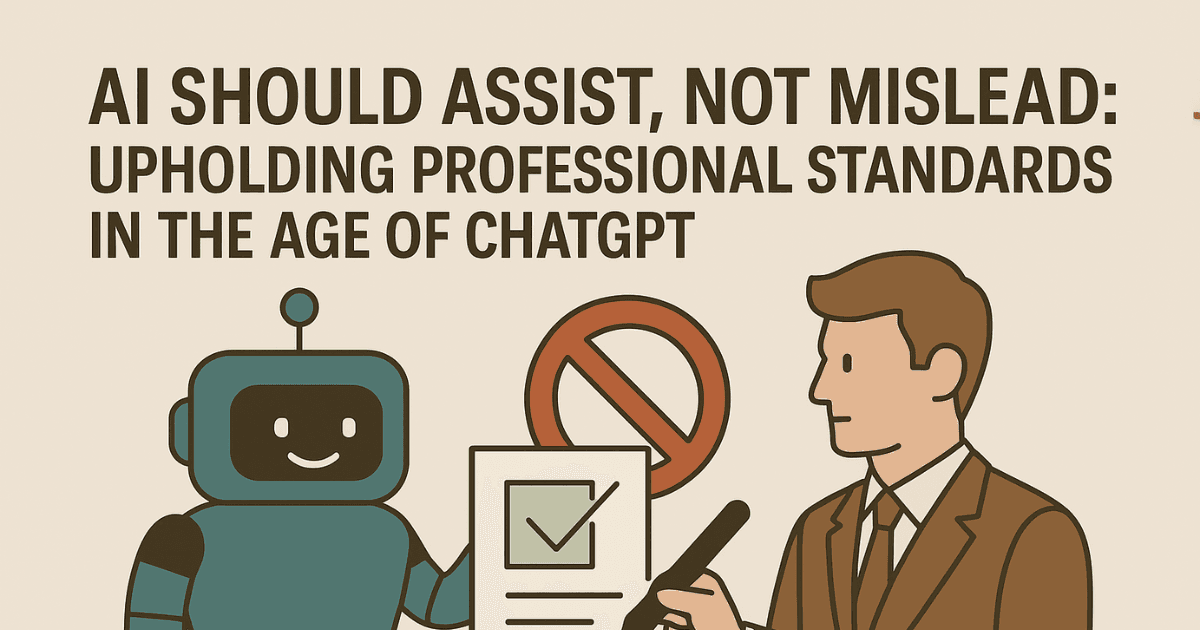
Artificial intelligence is transforming accounting. From automating research to streamlining client communication, AI has the potential to make professionals more efficient and effective than ever before. But with this new power comes new responsibility. As accountants begin incorporating tools like ChatGPT into their workflows, one principle must remain nonnegotiable: AI should assist — not mislead.
In the age of generative AI, upholding professional ethics isn’t just about human judgment anymore; it’s about how technology is used to support that judgment. The core standards that define the accounting profession — integrity, objectivity, due care, and professional competence — apply just as strongly when using AI tools as they do in every other aspect of practice.
The Rise of AI in Accounting
Ready to transform your practice with AI? Talk to Tax Stack AI about a custom system built for your firm.
AI tools have quickly become part of the modern accountant’s toolkit. Many professionals use them for drafting client emails, summarizing regulations, or brainstorming tax strategies. These applications can be valuable — but they also come with risk.
ChatGPT, for example, is a general-purpose language model, not a compliance or accounting expert. It can produce convincing, well-written answers that appear authoritative but lack verification or context. Without proper oversight, an accountant could unknowingly share incorrect or misleading information with a client.
That’s where professional ethics must step in. Technology should amplify expertise — not replace it.
Professional Ethics in the AI Era
The AICPA Code of Professional Conduct outlines the fundamental principles guiding all CPAs:
Integrity: Be honest and candid within the constraints of confidentiality.
Objectivity: Remain free of conflicts of interest and biases.
Due Care: Strive to continually improve competence and quality of services.
Professional Competence: Maintain the knowledge and skill to ensure accurate advice and representation.
When applying these principles to AI, the expectations are clear:
Accountants must validate AI-generated information before relying on it.
They must disclose limitations when technology is used to assist with analysis or research.
They must ensure that client confidentiality is never compromised through third-party platforms.
AI may assist in forming an answer, but it cannot shoulder ethical responsibility — that remains entirely with the human professional.
The Risk of Misleading AI
The most significant ethical challenge posed by general-purpose AI is its tendency to “hallucinate.” ChatGPT can produce inaccurate, fabricated, or outdated information — while expressing it with absolute confidence.
In a profession built on precision, this creates a dangerous illusion of reliability. For example:
A hallucinated IRS citation could misguide a tax position.
A fabricated accounting standard could alter financial reporting treatment.
An oversimplified response could omit crucial context required for compliance.
Even if the AI’s intentions are neutral, its output can mislead — and under professional ethics, intent doesn’t excuse inaccuracy. Accountants are accountable for every piece of information they rely on, regardless of where it originated.
Responsible AI Use in Practice
Upholding professional standards in the AI era means using technology intentionally and transparently. Accountants can apply the following principles to ensure responsible AI use:
Verify Every Output – Treat AI responses as starting points, not final answers. Confirm accuracy with primary sources like the Internal Revenue Code, IRS publications, or authoritative standards.
Protect Client Data – Never input sensitive or identifiable client information into consumer-grade chatbots that don’t guarantee confidentiality.
Disclose Limitations – If AI assists with research or drafting, clarify its role. Transparency builds trust and protects professional credibility.
Stay Informed – Keep up with regulatory and ethical guidance on AI use from bodies like the AICPA, PCAOB, and state boards of accountancy.
AI can streamline work — but it must always serve within ethical and regulatory boundaries.
Reinforcing Professional Judgment
AI is a tool, not a decision-maker. It can analyze patterns, summarize laws, or assist with drafting — but it cannot exercise judgment. Professional skepticism, ethical reasoning, and contextual understanding remain distinctly human capabilities.
The danger arises when professionals over-rely on AI as an authority rather than a resource. True value comes from combining human expertise with the efficiency of AI — not replacing one with the other.
Final Thoughts
As the accounting profession continues to evolve, the introduction of AI brings both promise and peril. The key to navigating this shift lies in ethical alignment — ensuring that every use of AI supports, rather than undermines, professional integrity.
ChatGPT and other general AI tools can be valuable assistants, but only when used responsibly and verified by human expertise. Accountants who integrate AI with care, transparency, and adherence to ethical standards will not only protect their licenses — they’ll strengthen the trust that defines their profession.
Because in the end, AI should never lead the profession astray. It should help accountants uphold the very standards that make their work indispensable.