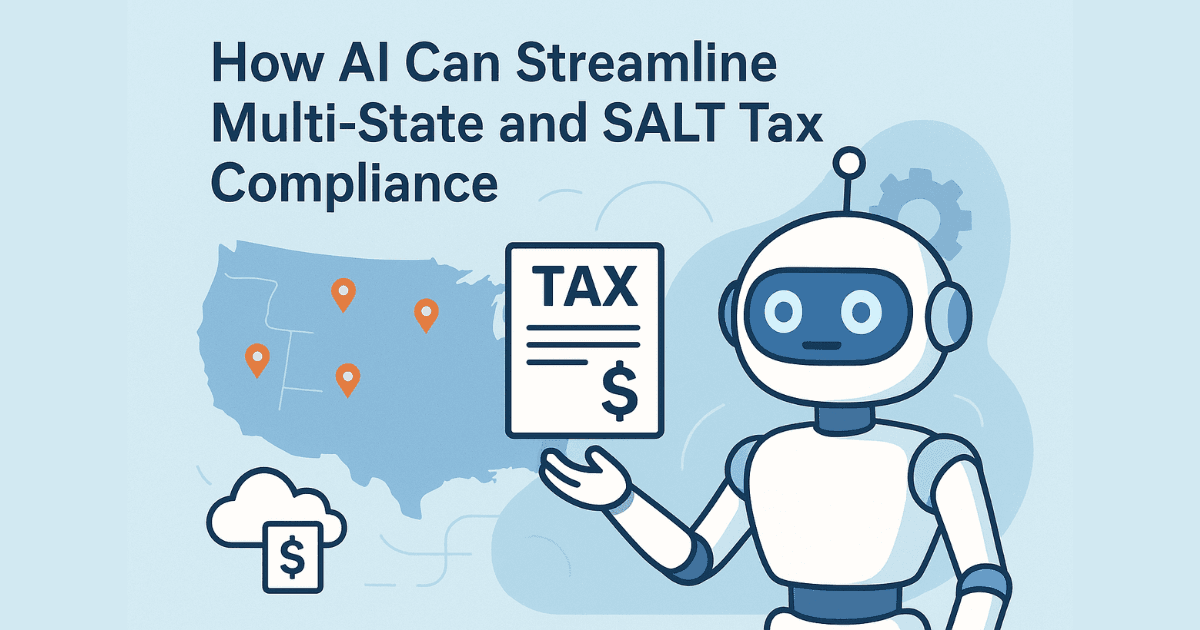
Navigating state and local tax (SALT) compliance is a growing challenge for businesses operating across multiple jurisdictions. Each state—and often local municipality—has its own rules, filing requirements, and deadlines. For CPAs and tax professionals, keeping up with constantly changing regulations can be time-consuming, error-prone, and stressful.
Enter artificial intelligence (AI). By leveraging AI-powered tools, tax professionals can streamline multi-state and SALT compliance, reduce errors, and provide clients with real-time guidance across jurisdictions.
1. The Challenge of Multi-State and SALT Compliance
Ready to transform your practice with AI? Talk to Tax Stack AI about a custom system built for your firm.
Multi-state tax compliance requires firms to manage:
- Different income tax rates and brackets
- Varying sales and use tax rules
- Local tax obligations, including city and county filings
- Frequent changes to tax laws and regulations
Even small errors—like filing a return late or miscalculating a deduction—can result in penalties and audits. For businesses with operations in multiple states, the complexity multiplies, making manual management nearly impossible at scale.
2. AI for Real-Time Regulatory Monitoring
One of AI's most powerful applications in SALT compliance is real-time regulatory monitoring. AI can:
- Track legislative updates across states and localities
- Analyze how new rules impact specific industries or business structures
- Automatically flag changes that may affect clients' tax obligations
This proactive approach ensures CPAs and their clients stay ahead of compliance risks, rather than reacting after an issue arises.
3. Automating Data Collection and Reporting
AI can dramatically simplify the process of collecting and reconciling data across multiple jurisdictions. For example:
- Pulling revenue and transaction data from various state systems
- Automatically categorizing income and expenses according to local tax rules
- Generating SALT-compliant reports for each jurisdiction
By automating these tasks, firms can reduce errors, save time, and allocate resources toward higher-value advisory work.
4. Ensuring Accuracy Across Jurisdictions
Multi-state compliance often requires cross-checking between federal, state, and local rules. AI-powered platforms can:
- Detect inconsistencies between filings in different states
- Validate calculations against up-to-date tax regulations
- Recommend corrections before filings are submitted
This reduces audit risk and enhances overall accuracy, giving clients peace of mind.
5. Enhancing Client Communication
AI can also improve how CPAs communicate SALT compliance updates to clients. Automated alerts, dashboards, and customized reports provide clients with:
- Clear explanations of their tax obligations in each jurisdiction
- Timely reminders for upcoming deadlines
- Insights into potential savings opportunities
This not only improves compliance but also strengthens client relationships through transparency and proactive guidance.
6. Preparing Your Firm for the Future
As businesses continue to expand across state lines, multi-state and SALT compliance will only become more complex. Firms that leverage AI for these challenges can:
- Reduce manual workloads and human error
- Stay current with evolving tax regulations
- Deliver high-quality, proactive client services
- Position themselves as leaders in multi-state tax advisory
Conclusion
AI is transforming multi-state and SALT tax compliance from a reactive, error-prone process into a streamlined, proactive solution. By automating data collection, monitoring regulatory changes, and enhancing accuracy across jurisdictions, AI allows CPAs to focus on higher-value advisory services.
For firms managing clients across multiple states, embracing AI isn't just an efficiency play—it's a competitive advantage that ensures compliance, accuracy, and superior client service.