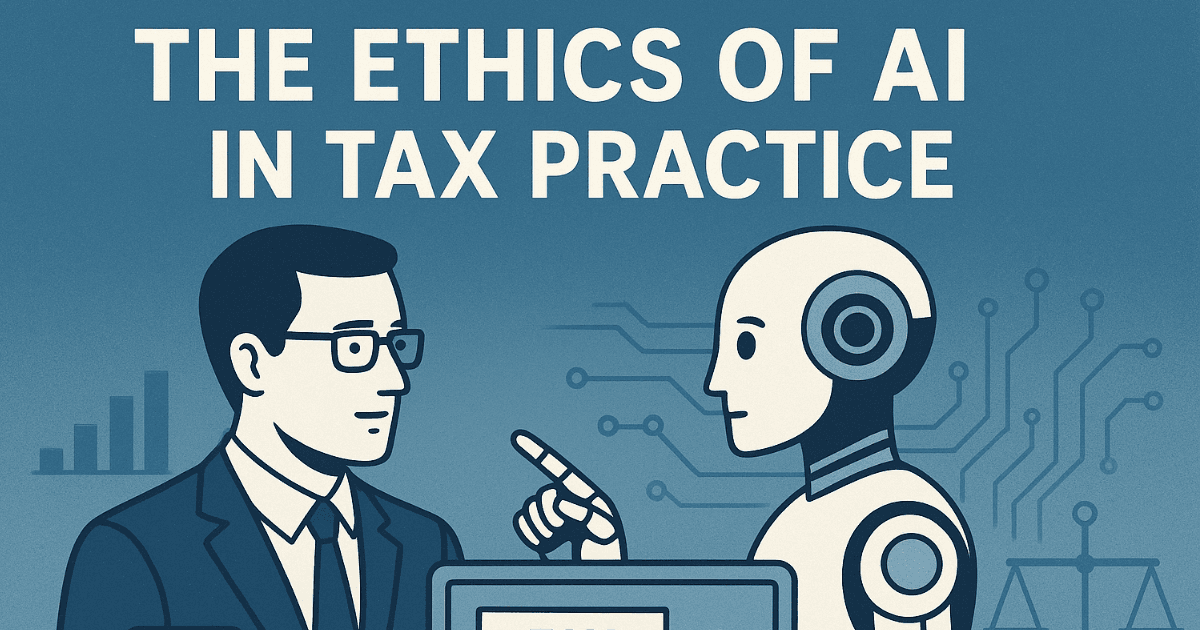
Artificial intelligence (AI) is rapidly transforming the accounting and tax landscape. From automating routine tasks to providing predictive insights, AI offers unprecedented efficiency and accuracy for tax professionals. But with these benefits comes a set of ethical considerations that cannot be ignored. CPAs must navigate the ethical implications of AI use in tax research, client recommendations, and decision-making to maintain trust, compliance, and professional integrity.
1. Accuracy and Reliability of AI Outputs
Ready to transform your practice with AI? Talk to Tax Stack AI about a custom system built for your firm.
One of the most important ethical considerations is ensuring the accuracy of AI-generated outputs. While AI can analyze vast amounts of data and identify patterns, it is not infallible. Errors in algorithms, outdated datasets, or misinterpretation of tax law can lead to inaccurate recommendations.
Ethical implications:
- Tax professionals have a duty to verify AI-generated results before relying on them for client advice
- Blind reliance on AI could lead to filing errors, compliance violations, or legal liability
2. Transparency and Explainability
AI often operates as a "black box," making decisions in ways that can be difficult to interpret. For CPAs, this presents a challenge: clients need to understand the basis for recommendations that affect their financial decisions.
Ethical best practices:
- Ensure AI-generated advice can be explained in understandable terms
- Maintain clear documentation of how conclusions were reached
- Avoid presenting AI outputs as unquestionable truths
3. Privacy and Data Security
AI tools often rely on sensitive client data to provide insights. Handling this information responsibly is critical to maintaining client trust and complying with regulations.
Key considerations:
- Use AI systems with strong encryption and secure data storage
- Limit access to client data and ensure only authorized personnel can review outputs
- Be transparent with clients about how their data is used and processed
4. Bias and Fairness
AI systems learn from historical data, which can embed biases—intentional or unintentional. In tax practice, biased outputs could lead to unequal treatment of clients or flawed financial strategies.
Ethical approaches:
- Regularly audit AI systems for bias in recommendations
- Cross-check AI outputs with professional judgment and industry standards
- Ensure AI usage supports equitable and fair treatment of all clients
5. Maintaining Professional Judgment
AI is a tool, not a replacement for professional expertise. CPAs must exercise judgment when interpreting AI insights, particularly in complex or novel tax scenarios.
Practical guidance:
- Use AI as a supplement to, not a substitute for, human decision-making
- Validate AI-generated recommendations against tax law and professional standards
- Document your rationale when diverging from AI outputs
6. Ethical Implications in Client Advisory
As CPAs move from compliance to advisory roles, AI can influence financial and strategic recommendations. Ethical practice requires transparency with clients:
- Clearly communicate the role of AI in shaping recommendations
- Avoid overpromising outcomes based solely on AI projections
- Ensure clients understand that human oversight guides final decisions
Conclusion
AI offers tremendous opportunities to enhance efficiency, accuracy, and insight in tax practice. However, ethical considerations must remain at the forefront. By prioritizing accuracy, transparency, fairness, and professional judgment, CPAs can responsibly integrate AI into their practice while upholding the trust and integrity that define the profession.
In the end, AI should empower CPAs—not replace their ethical responsibility to clients and the public.