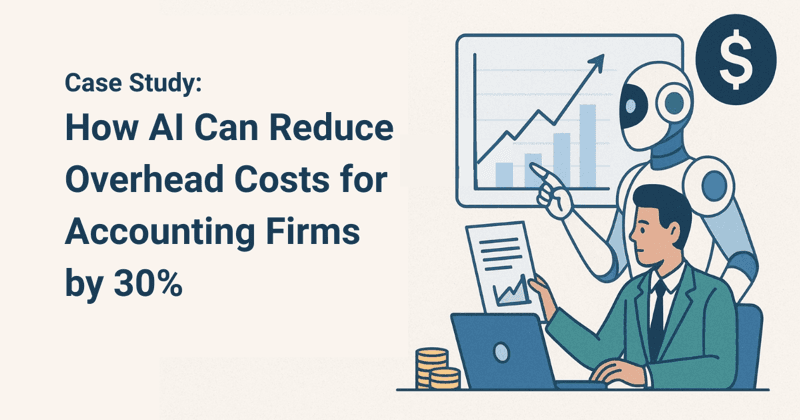
In recent years, artificial intelligence (AI) has emerged as a powerful tool for reducing overhead costs and enhancing efficiency across professional services—accounting included. This case study explores how AI-driven solutions can help small accounting firms cut overhead by up to 30%, supported by research and industry benchmarks.
Overhead Pressures in Small Accounting Firms
Ready to transform your practice with AI? Talk to Tax Stack AI about a custom system built for your firm.
Small accounting firms often face daunting challenges in managing overheads. Manual tax research, document analysis, and client management consume significant time and resources, reducing bandwidth for advisory services and client growth. Without the benefit of large-scale automation or enterprise systems, these firms face cost structures that quickly spiral out of control.
Evidence of Cost Reductions Across the Industry
AI in Accounting Outsourcing
According to the McKinsey & Company, 2023 Global Accounting Outsourcing Trends Report, AI-powered solutions in accounting outsourcing can reduce costs by up to 30%. This benchmark provides a strong foundation for understanding the impact of AI at scale—even within smaller firms adopting AI tools independently.
Efficiency and Productivity Boosts
A Stanford study of 277 accountants and 79 small-sized and mid-sized firms found that AI users close their books 7.5 days faster, spend 8.5% less time on back-office processes, and deliver more detailed financial reporting—suggesting improved quality alongside speed.
Broader Finance Sector Gains
Broader financial industry data shows that over 40% of effort can be redirected to higher-value tasks thanks to AI tools, with up to 44.5% of professionals reporting major efficiency gains. Firms also report reduced operational costs by up to 40% and labor savings of 30%.
How AI Delivers Overhead Savings—Through Three Key Capabilities
At Tax Stack AI, three core AI-powered tools help small accounting firms achieve cost efficiencies and reduce overhead:
1. AI-Powered Chatbot for Tax Research
Manual tax research is time-consuming and error-prone. An AI chatbot instantly delivers relevant, up-to-date findings. Firms eliminate hours of labor per query, reducing research-related time and overhead costs significantly. Rather than hiring or consulting additional expertise, accountants leverage the chatbot to deliver accurate answers swiftly.
2. Customer Management Tool with AI-Powered Insights
Traditional systems provide static data but offer little strategic insight. The AI-powered client insights tool surfaces patterns—like identified risk exposures or tax planning opportunities—without requiring analysts to comb through spreadsheets. This drives smarter use of personnel hours, shifting the focus from data gathering to value-add advising.
3. AI-Powered Document Analysis
Reviewing tax filings, contracts, and financial statements manually not only binds resources but also invites error. AI-powered document analysis extracts key data efficiently and highlights potential issues. Firms can serve more clients with fewer staff hours, cutting overhead dramatically.
Putting It All Together: A Small Firm's Cost Savings Scenario
Consider a hypothetical small accounting firm of 5 staff members working full-time on compliance, research, and document review. With traditional tools, a significant portion of time is spent on repetitive tasks. By adopting AI-powered tax research, insights, and document analysis tools, the firm could experience:
- 30% saved hours in research and document tasks
- 8.5% reduction in back-office processing time
- 40%+ reallocation toward higher-value advisory tasks
When combined, these gains translate into meaningful overhead reduction. Fewer billable hours are lost to low-value work; staffing and overtime costs decline. Additionally, improved employee satisfaction—by removing tedious tasks—further contributes to lowered turnover and recruitment expenses.
The Broader Impact: Beyond Cost Savings
While this case study centers on overhead reduction, AI delivers broader strategic value:
- Higher-quality outputs: Stanford research noted a 12% rise in reporting granularity, indicating improvements in accuracy and insight
- Competitive positioning: AI tools help small firms compete on service and responsiveness, not just price
- Scalability: With AI, firms can expand client capacity without proportionally increasing headcount
Conclusion
AI is no longer a luxury for large firms—it's a practical, accessible tool for small accounting firms seeking to streamline operations and cut overhead by as much as 30%. With the right technology—like Tax Stack AI—firms can reduce manual burden, reallocate resources to advisory services, and elevate both service quality and profitability.