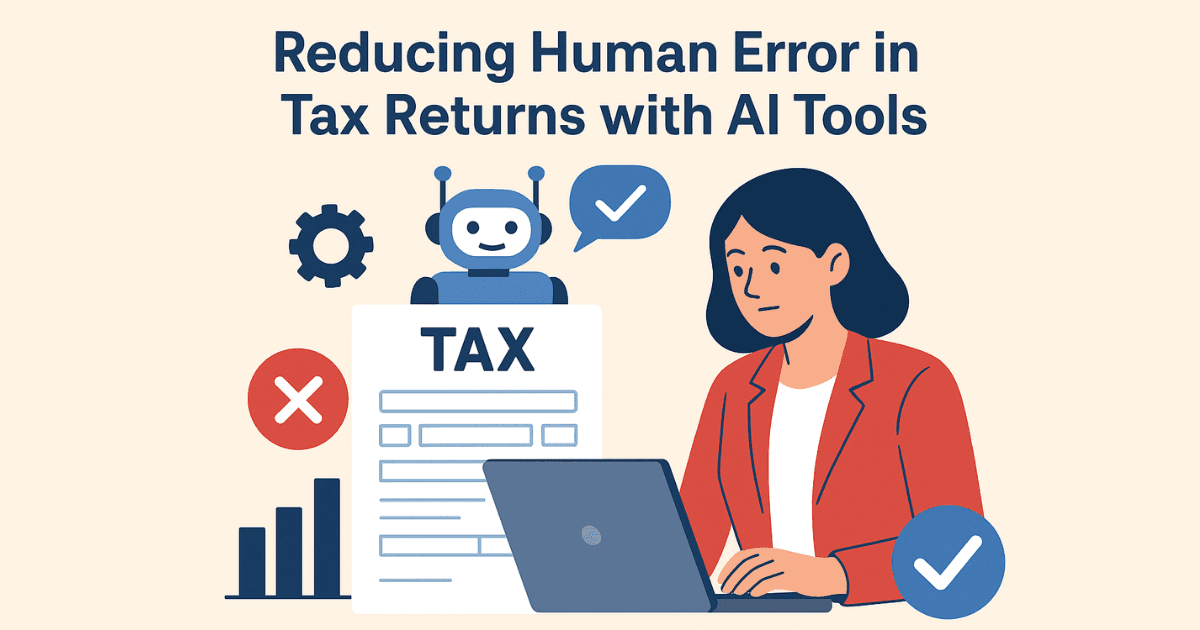
Accuracy is the cornerstone of any tax practice. Even small errors in data entry, calculations, or documentation can lead to penalties, audits, and unhappy clients. Traditional manual processes are inherently prone to mistakes, especially during high-volume tax seasons. Fortunately, artificial intelligence (AI) offers a powerful solution to reduce human error and streamline the tax preparation process.
1. How Human Error Impacts Tax Returns
Ready to transform your practice with AI? Talk to Tax Stack AI about a custom system built for your firm.
Common mistakes in tax preparation include:
- Transposing numbers or mis-entering client data
- Misclassifying income or expenses
- Missing deductions or credits
- Failing to comply with updated tax laws
These errors can be costly, not just financially but also in terms of client trust and firm reputation.
2. AI-Powered Data Entry and Validation
AI excels at automating repetitive data entry tasks. Using optical character recognition (OCR) and intelligent document processing, AI can:
- Extract information from client documents, W-2s, 1099s, and receipts
- Automatically populate tax forms with accurate data
- Cross-check data for inconsistencies or missing information
By automating these steps, firms can significantly reduce errors that often occur with manual entry.
3. Smart Calculations and Rule Enforcement
AI tools can apply complex tax rules consistently and accurately, minimizing mistakes in calculations. For example:
- Automatically calculating depreciation, amortization, or deductions
- Ensuring correct application of tax credits and incentives
- Alerting CPAs to potential errors or conflicts before filing
This allows tax professionals to focus on strategy and client advisory rather than worrying about math errors.
4. AI for Document Review and Audit Preparedness
Another common source of errors comes from incomplete or missing documentation. AI can help by:
- Reviewing client submissions for missing forms or supporting documents
- Flagging discrepancies between documents and input data
- Maintaining an organized, audit-ready digital record
This reduces the risk of penalties and ensures that clients have proper documentation in case of an IRS or state audit.
5. Workflow Integration and Error Tracking
AI tools can integrate seamlessly into existing tax workflows to continuously monitor for potential mistakes:
- Automatically track updates and changes in client data
- Provide error alerts in real-time during preparation
- Maintain logs for quality control and review purposes
Firms can use this data to improve internal processes, identify common sources of errors, and train staff more effectively.
6. Examples of AI Tools Minimizing Errors
Some of the AI-driven tools and platforms that are transforming tax accuracy include:
- Tax document automation software – Extracts and organizes client data efficiently
- AI-driven tax research platforms – Ensures calculations align with the latest tax law
- Predictive analytics and anomaly detection tools – Flags unusual transactions or potential misclassifications
By leveraging these tools, firms can confidently reduce human error and deliver more accurate returns.
Conclusion
Human error in tax preparation is inevitable—but it doesn't have to compromise your practice. AI offers powerful solutions to minimize mistakes in data entry, calculations, and documentation while freeing CPAs to focus on high-value advisory services.
Integrating AI into your tax workflow isn't just about efficiency—it's about accuracy, compliance, and delivering better outcomes for your clients. Firms that embrace AI today are not only reducing errors but positioning themselves for a smarter, more reliable, and forward-thinking tax practice.